Asset pricing research often focuses on risk, valuation and macroeconomic forces. But this paper highlights another surprisingly powerful driver of returns: the timing of dividend payments. In 44 international capital markets, the authors find a large and persistent “dividend premium”. Dividend-paying stocks outperform non-paying ones by a significant margin, even after controlling for traditional global and regional risk factors.
Dividend timing and the global dividend premium
- Allaudeen Hameed, Jing Xie and Yuxiang Zhong
- working paper, 2026
- A version of this paper can be found here here
- Want to read our summaries of academic finance papers? Check out ourAcademic Research OverviewCATEGORY
Key academic insights
Dividend-paying stocks outperform globally
Using data from 44 international capital markets between 1993 and 2018, the paper documents a strong dividend premium. Dividend-paying stocks outperform non-payers by about 0.58% per month after adjusting for global and regional risk factors. The effect is extremely widespread. The premium is positive in 95% of markets after factor adjustments, suggesting that dividend payout status represents a globally priced characteristic rather than a local anomaly.
The dividend premium has two distinct components
The authors show that the dividend premium is not a single phenomenon. It consists of a time-related component and a stable component. The time-related component comes from predictable investor demand around dividend events. Stocks earn unusually strong returns before ex-dividend dates, followed by only partial reversals afterward. The persistent component survives outside dividend event windows and appears to be related to governance and institutional quality.
Dividend timing creates predictable price pressure
One of the most important findings of the paper is that dividend demand is highly predictable. Dividend-paying stocks earn significantly higher returns during months when they are expected to go ex-dividend. Specifically, dividend payers earn 1.47% in forecast ex-dividend months versus 0.94% in non-ex-dividend months, and the payer-minus-non-payer spread increases to 1.01% during dividend months. Daily data reinforces this conclusion. Prices rise between the dividend announcement and the ex-dividend date, followed by only a fractional change thereafter. This pattern is consistent with temporary buying pressure from dividend-seeking investors.
Accumulating dividends amplifies returns
Dividend events are not evenly distributed throughout the year. In many countries, firms group dividend payments into specific months due to fiscal year-end conventions and payment practices. For example: nearly 60% of Japanese firms are awarded in March, 34% of Korean firms are awarded in December and 39% of Italian firms are awarded in May. The paper finds that larger clustering significantly increases the dividend premium. A one standard deviation increase in the ex-dividend cluster predicts a 0.18% higher dividend premium in the same month next year.
Global dividend premiums move together
Dividend premiums are not isolated effects at the country level. Markets with aligned dividend calendars experience stronger co-movement in dividend premiums. When payment schedules overlap internationally, investor demand shocks are synchronized across countries. The effect is economically huge. The overlap over the calendar average roughly doubles a country’s sensitivity to global and regional dividend premium factors. This creates a new explanation for global dividend style factors rooted in payment timing rather than just macroeconomic risk.
Governance matters
The persistent component of the dividend premium is stronger in weaker institutional environments. The premium is greater in markets with: lower liquidity, weaker investor protection, weaker securities regulation and pre-IFRS accounting environments. This suggests that investors value dividends more when corporate governance is less reliable. Dividends act as a reliable mechanism for returning cash to shareholders.
Taxes do not fully explain the premium
Traditional taxon-based explanations struggle to explain the findings. The paper shows that dividend premiums remain strong even in countries where dividends and capital gains are taxed similarly, or not at all. Hong Kong is a notable example. This undermines the view that dividend premiums are simply compensation for dividend taxation.
Practical applications for investment advisors
Dividend investing is about more than yield
Dividend-paying stocks can benefit from predictable investor demand, especially around concentrated payout periods. Advisors must recognize that the dynamics of dividend returns extend beyond just fundamentals.
Time matters
Dividend calendars create recurring seasonal effects. Understanding where dividend demand is concentrated can help explain short-term relative performance within equity markets.
Global diversification can change dividend exposure
Dividend timing varies significantly between countries. International diversification changes not only sector exposure and valuation, but also the time structure of dividend demand.
Governance still matters
The persistent dividend premium is stronger where governance quality is weaker. In some markets, dividends function as a signal of shareholder protection and capital discipline.
How to explain this to customers
“Dividend-paying stocks tend to perform better globally, but not just because of the dividends themselves. Investors often buy dividend stocks ahead of payout dates, creating predictable demand that pushes prices higher. Because many companies pay dividends at similar times, this effect can become large enough to affect entire markets. At the same time, dividends matter even where investors’ financial discipline is weak.” of the market because they are important. greater value for companies that consistently return cash to shareholders.”
The most important chart from the paper
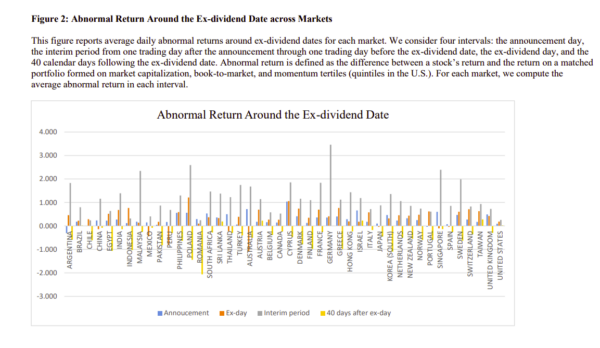
Results are hypothetical results and are NOT an indication of future results and do NOT represent returns actually achieved by any investor. Indices are not managed and do not reflect management or trading fees, and one cannot invest directly in an index.
ABSTRACT
Using data from 44 international stock markets, we document a strong dividend premium of 0.58%
per month after controlling for global and regional risk factors. We break this premium down into
a time-related component and a stable component. The time-related component arises in
predictable dividend months: dividend payers earn returns around the pooled ex-dividend
dates that only partially return, leaving a residue that doesn’t wash off. Within markets,
the premium is stronger when ex-dividend dates are more concentrated. Through markets, dividend
premiums co-move more strongly when payment calendars overlap, consistent with synchronized
trade demand shocks. The stable component survives out of dividend months and is
larger in weaker institutional environments (weaker investor protection, weaker disclosure and
securities regulation and lower liquidity). Taken together, the evidence points to that predictable payoff
time generates both return premiums and international return co-movement.
Dividend timing and the global dividend premium originally published in Alpha Architect. Please read the Alpha Architect FINDINGS at your convenience.