Digital payments are often seen as simple payment technology: faster transactions, lower friction and more convenience. But in reality, cashless payments generate something much more valuable: data. Each purchase reveals information about income stability, spending habits, liquidity and financial behavior. This paper presents a deeper perspective: digital payment systems are not just transactional infrastructure. They are information systems that can reshape credit markets.
Cashless payment and financial inclusion
- Shumiao Ouyang
- Journal of Financial Economics, 2026
- A version of this paper can be found here here
- Want to read our summaries of academic finance papers? Check out ourAcademic Research OverviewCATEGORY
Key academic insights
Digital payment data expands access to credit
The paper studies whether cashless payment activity causally increases consumer credit access. Using Alipay’s proprietary data and a new instrumental variables strategy, the author shows that higher in-person digital payment activity significantly increases both the probability of credit receipt and the size of credit lines. The results suggest that payment flow data contain valuable information for credit evaluation.
Tthat study identifies a causal effect
One challenge is that consumers who use digital payments more often may already differ from non-users in important ways. To address this, the paper exploits the gradual spread of shared bikes integrated with Alipay across Chinese cities. Bike sharing encouraged consumers to accept Alipay for in-person payments by scanning the QR code. This created a reliable exogenous variation in payment activity that allowed the author to isolate the causal effect of cashless payments on credit provision.
Access to credit increases significantly after payment approval
The results are economically significant. Using digital payments in person increases the probability of getting access to credit by approximately 56%. Among consumers who already have access to credit, a 1% increase in payment flow increases credit lines by about 0.41%. The findings suggest that payment behavior itself becomes an important input into lending decisions.
Payment information matters beyond repayment history
Traditional consumer lending relies heavily on repayment histories and formal credit records. This paper shows that ordinary payment activity also matters. Even after excluding repayment-related transactions, the positive relationship between payment flow and loan provisioning remains strong. Evidence suggests that lenders learn about borrower quality directly from payment behavior.
The effects of financial inclusion are stronger for underserved groups
The paper finds that older and less educated consumers benefit more from adopting digital payments. These groups traditionally engage in fewer financial activities and often have poorer access to formal credit markets. When they start using digital payments, lenders gain more information about their financial behavior, leading to greater increases in access to credit.
The mechanism reflects information, not just collateral
One possible explanation is that consumers with larger balances on the platform receive more loans because those balances act as collateral. The paper tests this directly by checking for assets held in Alipay. The effects remain strong. This suggests that the informational value of payment data itself is the primary mechanism driving expanded credit access.
Easier access to credit does not appear to increase compulsive spending
The paper also studies whether increased access to digital credit leads to harmful consumer behavior. Using detailed transaction-level data, the author finds little evidence that consumers increase compulsive spending categories as they gain additional access to credit. Spending increases overall, but not disproportionately in categories related to impulsive behavior.
Practical applications for investment advisors
Understand the growing role of payment data
Digital payments are becoming an important source of financial information. Payment activity can increasingly serve as an alternative form of credit assessment, especially for consumers with limited traditional credit histories.
BigTech firms can have durable informational advantages
Firms that control large payment ecosystems can have significant advantages in consumer lending because they observe behavioral data in real time. This creates potential competitive advantages over traditional financial institutions.
Financial inclusion can create new growth opportunities
As underserved populations gain access to digital payments, they can also access broader financial products such as loans, savings, insurance and wealth management services. This can expand long-term financial participation in developing economies.
Be aware of regulatory and privacy risks
The same payment data that improves access to credit also raises concerns about privacy, market power, and algorithmic discrimination. Policymakers may increasingly scrutinize how financial data is collected and used.
How to explain this to customers
“Cashless payments do more than make transactions easier. Every digital payment creates information about spending behavior, income patterns and financial habits. This paper shows that lenders can use that information to evaluate borrowers who may not have traditional credit histories. As more people adopt digital payments, especially in developing economies, payment platforms can help expand financial access to consumers who were previously unserved by payments.” They are information systems that can change the way credit markets work.
The most important chart from the paper
Fig. 1. Penetration of mobile payments across countries. These figures show the mobile payment transaction volume adjusted by GDP per user and the mobile payment penetration rate for selected countries in 2019 and 2023. Data sources are Statista Digital Market Outlook and the World Bank.
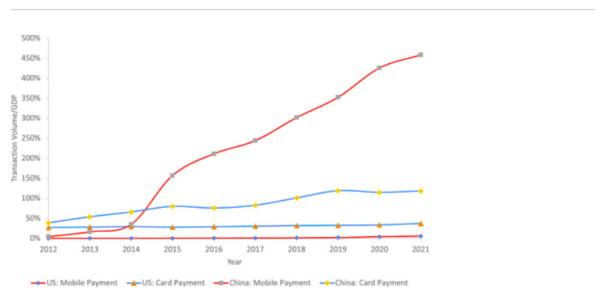
Results are hypothetical results and are NOT an indication of future results and do NOT represent returns actually achieved by any investor. Indices are not managed and do not reflect management or trading fees, and one cannot invest directly in an index.
ABSTRACT
This paper investigates how cashless payment affects credit access for underserved populations using data from Alipay, a leading Chinese BigTech platform with over 1 billion users that offers a wide range of financial services. Using the scaled diffusion of Alipay-connected shared bicycles across cities as a natural experiment and analyzing a representative sample of Alipay users, I find that the adoption of cashless payments increases credit access by 56.3% and that a 1% increase in payment flow increases credit lines by 0.41%. These effects are stronger for less educated and older individuals, who have traditionally faced greater barriers to accessing financial services.
Cashless payment and financial inclusion originally published in Alpha Architect. Please read the Alpha Architect FINDINGS at your convenience.