Insider trading is usually built around CEOs, board members and officially designated insiders. These are the people regulators keep a close eye on. Their trades must be disclosed. Their transactions are scrutinized by investors, journalists and compliance departments. But modern corporations contain many other employees with access to valuable information. This paper studies whether these “under the hood” executives trade profitably with material non-public information.
Flying Under the Radar: Insider Trading by Executives Below the Top
- Hans K. Hvide, Kasper Meisner Nielsen
- Journal of Financial Economics, 2026
- A version of this paper can be found here here
- Want to read our summaries of academic finance papers? Check out ourAcademic Research OverviewCATEGORY
Key academic insights
Under-executives earn abnormal returns in their company’s markets
The paper shows that executives below the top level generate large economically abnormal returns when they buy their employer’s stock. Depending on the methodology, abnormal returns amount to approximately 68 to 101 basis points over one month and approximately 250 basis points over six months.
Abnormal returns do not appear in unrelated stocks
The same individuals fail to perform better when trading stocks unrelated to their employer. In fact, non-inside purchases generate negative abnormal returns. This strongly suggests that the results are driven by informational advantages rather than general investment skills.
Industry expertise does not explain the results
Executives also fail to outperform when trading other firms in the same industry. Same industry trades generally produce negative abnormal returns. This rules out the idea that sector knowledge alone explains returns.
Top executives perform worse than executives below
Interestingly, top drivers generate smaller and often statistically insignificant ones abnormal returns. The paper suggests that higher visibility and regulatory scrutiny may discourage top executives from exploiting informational advantages so aggressively.
Employees also seem to benefit from insider information
The study extends beyond executives and finds positive abnormal returns among non-executives as well. Abnormal returns appear throughout the wage distribution, although higher-wage workers trade more often.
Abnormal returns persist over time
Profits from domestic purchases continue to accumulate over several months. This pattern suggests that managers are not simply reacting more quickly to public information, but may have valuable information that markets gradually incorporate.
Trading through family members or LLCs does not seem important
Researchers examine whether executives hide trades through family accounts or private companies. They find little evidence of abnormal returns from these indirect channels, suggesting that more informed trading occurs through personal brokerage accounts.
Practical applications for investment advisors
Understand that insider activity may extend beyond reported filings
Internal public records can capture only a portion of the informational trading that occurs within corporations. Important information may be disseminated well below the CEO and board level.
Avoid over-interpreting executive buys in isolation
Not all insider activity comes from executives that investors typically monitor. Significant informational advantages may exist among operational managers and senior employees that are invisible to traditional discovery systems.
Understand the limits of market efficiency
The persistence of abnormal returns over multi-month horizons suggests that markets may incorporate firm-specific information more slowly than many investors assume.
Separate informational advantages from investment skills
The paper demonstrates the importance of distinguishing between true stock-picking ability and informational advantages associated with organizational proximity.
How to explain this to customers
“This paper examines whether executives below the top management level trade on material non-public information. Using comprehensive Norwegian administrative data covering all stock trades from 1997 to 2014, the authors analyze the abnormal returns earned by executives who buy their employer’s stock. They find economically large and statistically significant abnormal returns on insider buyouts, while abnormal returns are same in insider purchases.Same industry evidence suggests that insider trading activity extends beyond formally defined insiders and may occur widely among executives and employees operating below traditional disclosure thresholds.
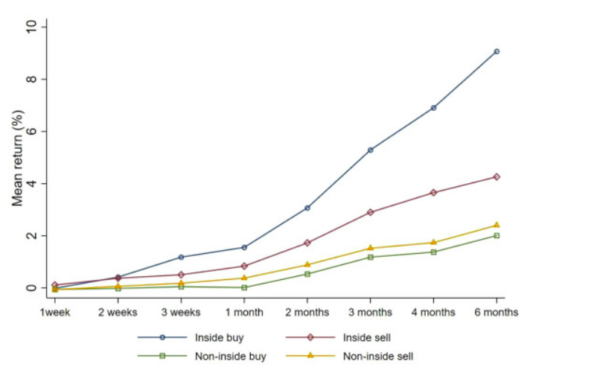
The most important chart from the paper
This Figure. reports the average return on trading by the top executives. We report the average buy-and-hold return after insider purchases, insider sales, non-insider purchases, and non-insider sales over horizons from 1 week to 6 months.
Results are hypothetical results and are NOT an indication of future results and do NOT represent returns actually achieved by any investor. Indices are not managed and do not reflect management or trading fees, and one cannot invest directly in an index.
ABSTRACT
To enforce insider trading laws, financial regulators require senior executives to make their company’s trades public. One implication of this regulatory focus is that executives below the top fly under the radar. We use administrative register data from Norway to examine whether junior executives in listed companies earn abnormal returns from purchases in their company’s stock. We find evidence of abnormal returns on such trades, around 50 to 100 basis points over the 1-month horizon. Abnormal returns from purchases in other stocks are negative, making high investor skill an unlikely explanation.
Flying Under the Radar: Insider Trading by Executives Below the Top originally published in Alpha Architect. Please read the Alpha Architect FINDINGS at your convenience.