Institutional investors must process information efficiently, read everything that matters, and adjust portfolios rationally. But in practice, attention is scarce. Funds must choose what to read, when to read it and whether to focus on macro conditions or individual firms. This letter opens that black box. Using direct data on what institutional investors actually read online shows that attention is a real economic resource. Funds that reallocate attention to macro news when volatility increases perform better. Funds also pay more attention to the stocks they own, and this attention helps them make better position and trading decisions.
Attention institutional investor
- Alan Kwan, Yukun Liu, Ben Matthies
- Journal of Finance, 2026
- A version of this paper can be found here here
- Want to read our summaries of academic finance papers? Check out our Academic Research Overview CATEGORY
Key academic insights
Funds shift attention to macro news when uncertainty increases
The paper shows that institutional investors reallocate attention towards macroeconomic and aggregate market news when aggregate volatility is high. This is consistent with limited attention theories, which predict that macro information becomes more valuable during turbulent periods.
Funds that better reallocate attention earn higher returns
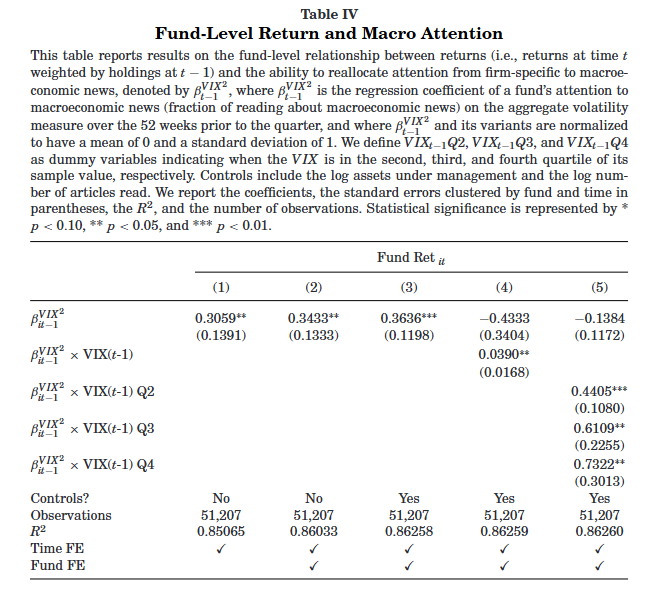
A fund’s ability to shift attention to macro news when volatility increases predicts better future performance. Funds with higher sensitivity to macro attention outperform by about 0.48% per quarter, or roughly 1.9% annually, and this performance is stronger when aggregate volatility is high.
Attention and portfolio holdings are closely related
Funds pay much more attention to stocks they already hold than to stocks they don’t. On average, they read about held stocks about five times more than non-held stocks, and within portfolios, larger positions receive more attention. This supports the idea that investors focus attention where they expect it to be most important.
Firm-specific attention adds value to positions
Attention to a stock predicts greater added value at the position level. Stocks that receive more attention contribute more to future portfolio performance, especially when the fund already holds a large position or is making a meaningful trade.
Mindfulness improves business decisions, especially purchases
Fund attention to a stock is positively related to trade-based value added. In other words, mindful trading is more profitable. This effect is particularly strong for purchases than for sales, consistent with the view that purchase decisions require more information production than sales decisions.
Attention from sophisticated investors predicts future returns
At the stock level, attention buying funds predict future returns, especially when the attention comes from hedge funds. Stocks that attract more attentive buying subsequently perform better, suggesting that investor attention helps shift information into prices, but not immediately.
Practical applications for investment advisors
Treat attention as an investment resource
Investment skill is not just about security selection. It is also about where to allocate limited research capacity. The paper suggests that the best managers direct attention to the most relevant information for timely decisions.
Look at the process, not just the results
Managers who can shift focus to macro conditions during periods of high volatility may have a more adaptive investment process. This flexibility appears to be associated with better performance.
Use obedience and attention together
The paper shows that attention is most valuable when associated with meaningful position size or meaningful trades. In practice, this suggests that investors should focus their deepest research efforts where conviction and capital commitment are highest.
Separate the useful information from the noise
Attention to business and financial news creates more value than attention to retail or general oriented news. This reinforces the importance of filtering signal from noise in portfolio management.
How to explain this to customers
“Successful investing isn’t just about having access to information. It’s about knowing where to focus limited attention. This study shows that the best institutional investors shift their focus to big-picture macro risks when markets become more volatile and to the individual stocks that matter most in their portfolios. This attention appears to improve both portfolio construction and trading decisions.
The most important chart from the paper

Results are hypothetical results and are NOT an indication of future results and do NOT represent returns actually achieved by any investor. Indices are not managed and do not reflect management or trading fees, and one cannot invest directly in an index.
ABSTRACT
Using data on Internet news reading, we measure fund-level attention to both general and firm-specific news and relate them to financing portfolio allocation decisions. In the time series, we find that funds shift attention to macroeconomic news during periods of high aggregate volatility. Those funds that exhibit stronger patterns of reallocation of attention earn higher future returns. In the cross section of fund portfolios, fund attention is positively related to stock holdings. Additionally, the fund’s attention to a stock increases the value added of that position to the fund’s performance. This relationship is stronger using the fund’s attention to news articles that have more value.
–
Important discoveries
For informational and educational purposes only and should not be construed as specific investment, accounting, legal or tax advice. Some information is considered reliable, but its accuracy and completeness cannot be guaranteed. Third party information may become out of date or be replaced without notice. Neither the Securities and Exchange Commission (SEC) nor any other federal or state agency has approved, determined the accuracy, or confirmed the adequacy of this article.
The views and opinions expressed herein are those of the author and do not necessarily reflect the views of Alpha Architect, its affiliates, or its employees. Our full disclosures are available here. Definitions of common statistics used in our analysis are available here (towards the end).
Join thousands of other readers and subscribe to our blog.