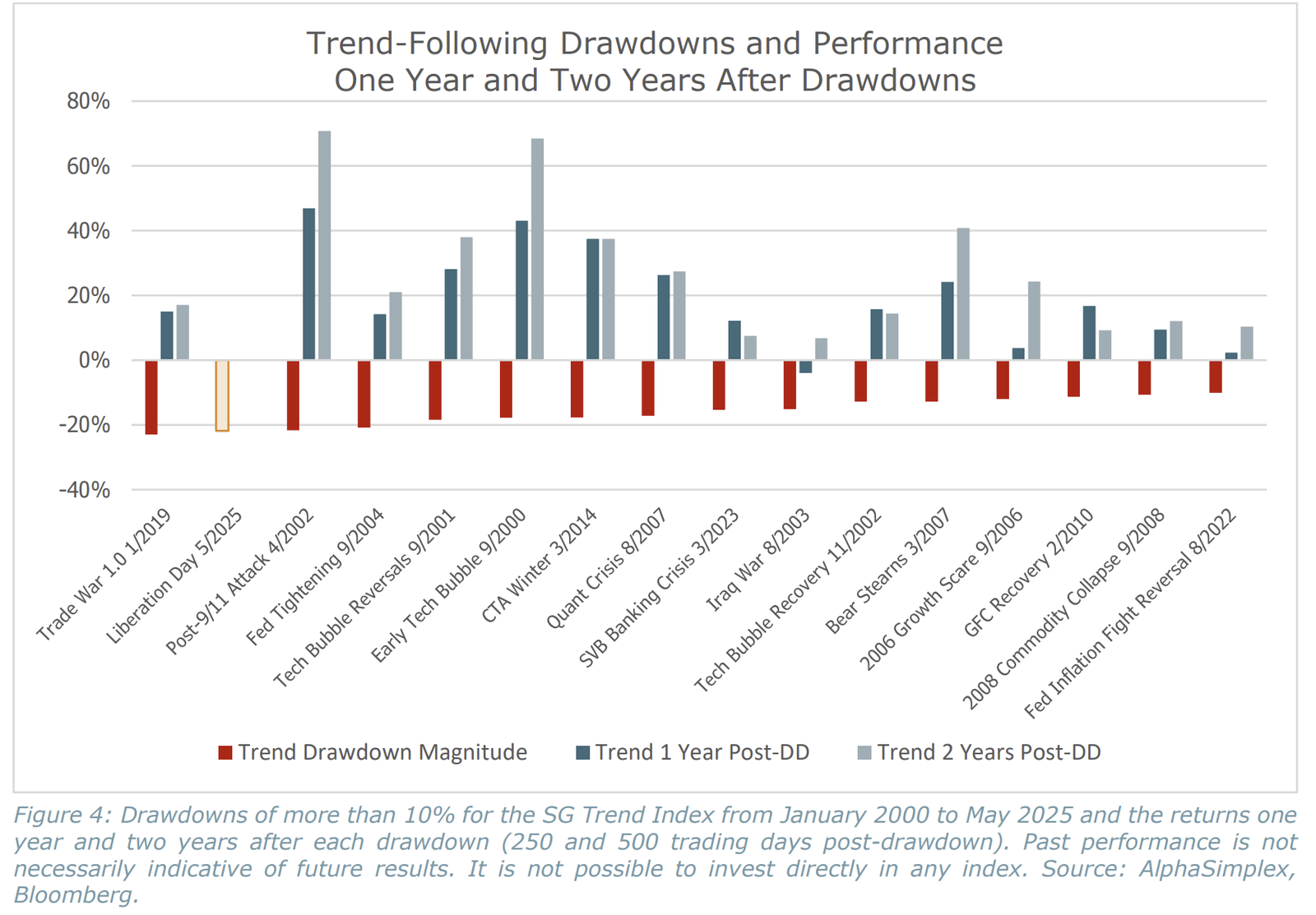
On April 2, 2025, one of the biggest market shocks since 2020 hits the financial markets. Out of left field, President Trump announces punitive tariffs left and right and most financial assets begin to flow. In desperation, investors look for a safe haven. Ironically, trend following – long considered a source of the alpha crisis – experiences one of the worst pullbacks in history.1 Wow, wow. The exits begin.
What follows could not be more beautifully written. Gold rises, the dollar is crushed and silver goes on an all-time high as trends begin to take shape. By the end of the year, the sector finishes firmly in the green. Then comes 2026. January still sees strong returns, even though it ends with one of the metal’s sharpest trend reversals ever.2 March brings one of crude oil’s wildest moves since going negative in 2020, as oil nearly doubles from around $60 to $120 in the span of a week, only to drop back down to $90 overnight. This thing is finally moving while US stocks are flat!
And so—as with most assets or strategies that deliver strong returns—investors may be looking at this particular strategy and asking: Is it time to enter?
The answer, while not surprising, is definitely nuanced. In this post, I continue my conversation with Dr. Kathryn Kaminski, Chief Research Strategist and Portfolio Manager at AlphaSimplex, to explore whether investors should share the trends behind this latest rally.
If you want to watch my conversation with Dr. Kaminski, be sure to check out the latest episode on our YouTube channel:
Let’s begin.
The trend is, surprisingly, a bad return
Dr. Kaminski wrote a paper after the tariff turmoil investigating the behavior of the trend after the pullback3. Her results show that trend programs tend to post strong returns after their worst pullbacks.4. In her book Trend following with managed futures5Dr. Kaminski also finds negative autocorrelation in trend-following futures strategies. Periods of high performance tend to be followed by periods of underperformance, and periods of underperformance tend to be followed by periods of high performance.

From this, we can conclude that if investors are going to split the trend tactically, it is better to do so during the down cycle, not during the up cycle.
It is the shocks that serve as the catalyst for the trends
You may have turned away from trend investing because “information just travels too fast.” It certainly seems like the trend had some of its best performances when information was scarce, computers were hard to find, and speculators drew fancy lines on paper charts. Those days are gone.
Personally, while I believe the premium has definitely compressed, the following trend rests on a fundamental reality of human survival: adaptability. “Trend following is about following the themes in the market as they evolve using a data-driven approach,” Dr. Kaminski emphasized during our conversation. Critically, evolution usually stems from a catalyst or shock to the ecosystem.
Unfortunately for the trend, this is not a strategy that aims to take advantage of shocks – so it’s a coin flip whether it will react positively or negatively to these events. Having said that, it is important to note that, as Dr. Kaminski, “it’s the change after that friend that slowly comes to the markets that creates new trends.” It was the April 2025 selloff that ignited the dollar trend and fueled the metals trend. Recently, it was the Iran conflict that supported the energy trend.6 These shocks move markets from a state of stability to a state of instability. Fortunately for us, the trend is trending flourish during volatility.
The trend is structurally different… And that’s GREAT!
“Trend following is one of the only strategies that is very, very different. It actually has low correlation over long time horizons with things like stocks,” said Dr. Kaminsky.
Trends like volatility, while stocks like stability. Stocks experience frequent small gains and occasional large losses, while trends tend to experience frequent small losses and occasional large gains. These two assets are a match made in heaven. While the trend will not always save the day (especially during rapid equity crashes7) some level of trend following in high-cap portfolios is likely to significantly improve portfolio results.
CONCLUSION
So is it time to buy? While bullish periods for the trend tend to signal future mean reversion, it is almost impossible to say exactly when these inflection points will be reached. So yes, while from a tactical perspective the trend doesn’t look that attractive, from a strategic perspective, I think most investors would benefit from incorporating the trend into their portfolios. The benefits of diversification are just as good. How one starts the distribution is a matter of discretion – but the allocation question is, in my opinion, already settled.
- To be fair, the peak had come from one of the best years in its history. ↩︎
- These adjectives may sound like hyperbole, but really, these moves have really been that extreme! ↩︎
- Kaminski, Kathryn M., and Shihong Wen. Market cycles and managed futures pullbacks: An empirical analysis of managed futures pullback and recovery periods. AlphaSimplex Group, June 2025. ↩︎
- Which also tend to be much shallower than equity withdrawals. ↩︎
- Alex Greyserman and Kathryn Kaminski, Trend Following with Managed Futures: The Quest for Crisis Alpha (Hoboken, NJ: John Wiley & Sons, 2014). ↩︎
- We still have to see how this plays out! ↩︎
- Tail defense is much better at that job. ↩︎
–
Important discoveries
For informational and educational purposes only and should not be construed as specific investment, accounting, legal or tax advice. Some information is considered reliable, but its accuracy and completeness cannot be guaranteed. Third-party information may become outdated or otherwise replaced without notice. Neither the Securities and Exchange Commission (SEC) nor any other federal or state agency has approved, determined the accuracy, or confirmed the adequacy of this article.
The views and opinions expressed herein are those of the author and do not necessarily reflect the views of Alpha Architect, its affiliates, or its employees. Our full disclosures are available here. Definitions of common statistics used in our analysis are available here (in the last direction).
Join thousands of other readers and subscribe to our blog.