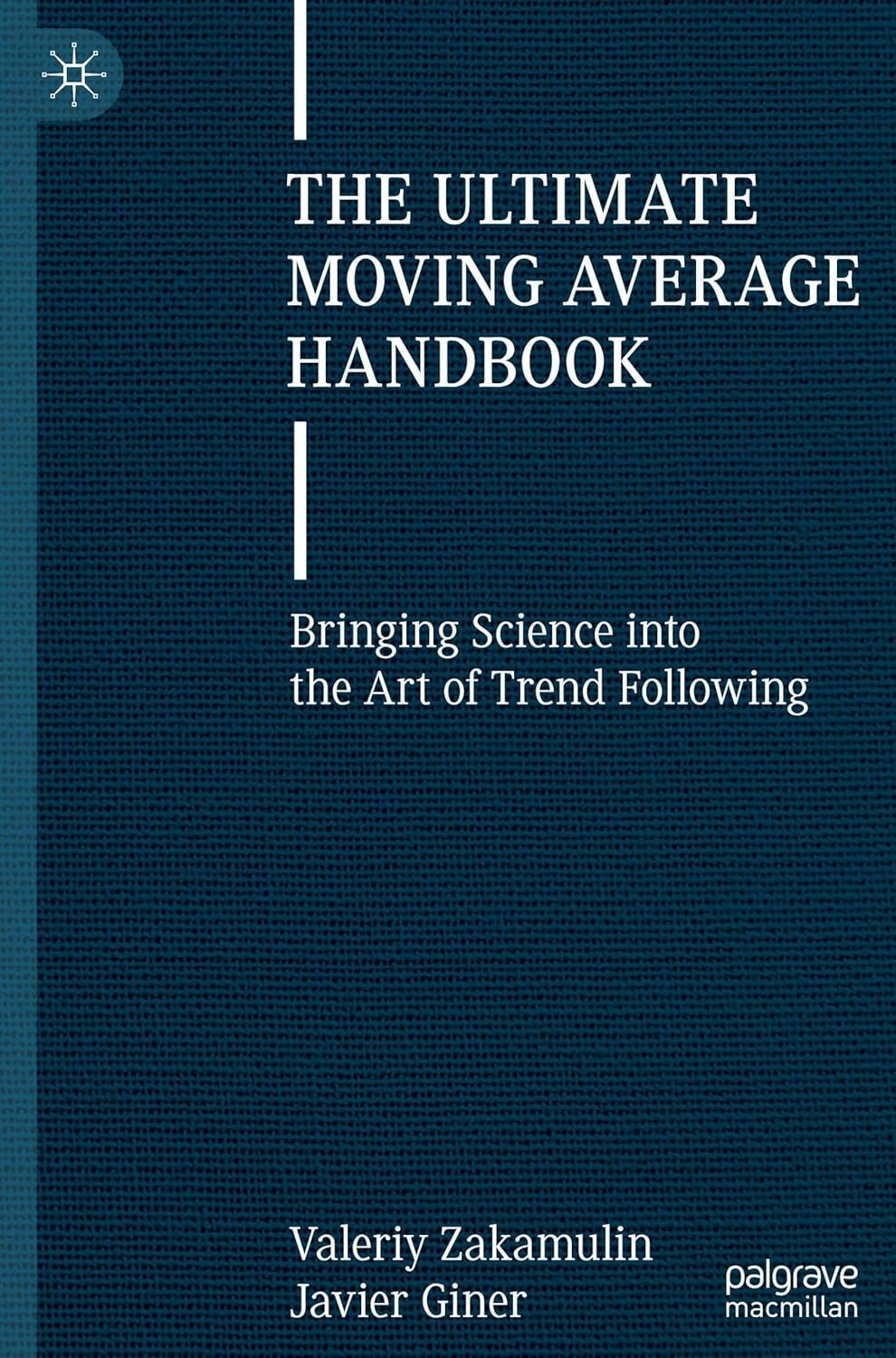

The motivation of the book
My friend Valeriy has produced some great trend after research articles over the years (most of which are on this blog!). Of course, trend following is not new. Traders have been following trends for centuries, and moving averages are the main tool behind them all. The basic idea is simple: markets are noisy, so smooth out the data and try to extract the signal.
Sounds straightforward – until you realize there are hundreds of ways to do it. (we have one the entire article category dedicated to this!)
Over time, we have seen an explosion of moving averages and trading rules. Each of them claims to be faster, smoother or somehow “better”. You will hear terms like zero delay, super calmOR Based on DSP thrown around as if they were discoveries.
But here’s the problem: most of these claims don’t stand up to scrutiny.
Evidence is usually anecdotal. Maybe a nice looking board. Maybe a backtest with favorable assumptions (they always look good, don’t they?). Rarely do we see a rigorous, apples-to-apples comparison based on data.
So we’re left with a fragmented field—too many ideas, too little structure, and almost no consensus on what actually works.
This book is an attempt to fix that. The goal is simple: replace intuition, marketing and hand-waving with a disciplined and quantitative framework. Instead of asking “which moving average looks better”, we ask a better question – what are the underlying trade-offs and how do different methods stack up when you measure them properly?
What the book covers
Book combines two perspectives: 1) it is both a comprehensive guide to moving averages and 2) a new analytical framework for understanding them.
Basically it’s a simple idea that is often overlooked: any trend following rule should be judged on three dimensions:
- LIABILITY (how quickly you react)
- softness (how much noise it filters)
- The accuracy (how well it tracks the underlying trend)
Most practitioners focus on the first two, often assuming that softer means more accurate. This is a mistake. Smoothness controls noise, but accuracy is about how closely you track the underlying trend—and the two don’t always move together
This book constructs quantitative measures for all three—and then uses them to compare the methods on a level playing field.
Once you do this, a few things become clear:
- Many “different” methods are simply variations of the same basic structure
- Claims of “zero lag” or “super quiet” always come with trade-offs
- There is no free lunch – every improvement in one dimension costs you in another
From there, the book moves from analysis to design.
- How to build better rules?
- How do you balance competing objectives?
- What does “optimal” even mean in a real-world setting?
The book also addresses the messy reality of implementation—how trading costs matter, why backtests can be deceiving, and how market dynamics change the game.
In short, the book is not just a reference—it is an attempt to turn a largely intuitive field into a coherent and quantitative discipline.
I highly recommend you watch it. Here it is amazon link.
–
Important discoveries
For informational and educational purposes only and should not be construed as specific investment, accounting, legal or tax advice. Some information is considered reliable, but its accuracy and completeness cannot be guaranteed. Third party information may become out of date or be replaced without notice. Neither the Securities and Exchange Commission (SEC) nor any other federal or state agency has approved, determined the accuracy, or confirmed the adequacy of this article.
The views and opinions expressed herein are those of the author and do not necessarily reflect the views of Alpha Architect, its affiliates, or its employees. Our full disclosures are available here. Definitions of common statistics used in our analysis are available here (in the last direction).
Join thousands of other readers and subscribe to our blog.