New research challenges a long-standing rule of thumb in momentum investing — and reveals surprising insights into when to use it
For decades, investors using momentum strategies have followed a simple rule: ignore last month’s returns. This “skipping-month” convention has been standard practice since the 1990s, designed to avoid short-term reversion effects, where stocks that rise one month tend to fall again the next.
But what if that ignored month is telling you something important?
Dibyam Dikhit, author of the January 2026 paper “The most recent month’s informative role in industry-level momentum strategies“, examined nearly 50 years of industry-level returns and found that the most recent month contains economically meaningful information—not just noise to filter out. The findings suggest that investors should think of the skipped month rule differently: not as a universal best practice, but as a contingent tool that works better in some market environments than others.
What did Dikhit consider?
The study analyzed Fama-French 48 industry portfolios from 1975 to 2024, comparing two momentum strategies with analysis focused on long-only momentum portfolios, in which returns are calculated as an equal weighted average of selected industries during the holding month:
Strategy 12-1 (standard approach): Sorts industries based on their returns from the previous 12 months to the previous 2 months, clearly excluding the most recent month. Each month, the strategy invests equally in the top 5 performing industries.
The 12-0 Strategy (includes the last month): Sorts industries based on returns from the previous 12 months to the previous month, including the most recent month in the calculation.
Rather than simply asking which strategy performed better, the researcher dug deeper: How do returns and volatility from the past month help predict future performance? And how does including or excluding that month change the sensitivity of the strategy to different market conditions?
To answer these questions, the study classified each month into regimes based on whether the previous month’s return was above or below its trailing average and whether volatility was elevated or calm. This created four distinct market states:
- Steady trend: Recent above-average returns and below-average recent volatility
- Overheated: Recent above average returns and recent above average volatility
- Slow division: Below-average returns and below-average recent volatility
- Stress/Clash: Below-average returns and above-average recent volatility
Key findings
1. Previous month’s strong returns predict stronger momentum
Contrary to conventional wisdom for the short term subversionthe study found that when the previous month delivered above-average returns, the subsequent performance of the moment was significantly stronger. This was true in both strategies, but the effect was more pronounced in the 12-1 portfolio.
For the 12-1 strategy, the months following the previous month’s strong returns generated average returns of 2.03% compared to 1.28% following the previous weak months—a 59% difference. The 12-0 strategy showed the same direction pattern, but with a smaller spread (1.69% vs. 1.62%).
2. High volatility dampens momentum—Even when returns are strong
Volatility in the past month proved to be a strong predictor of current underperformance. When the previous month was quiet (below-average volatility), both strategies thrived, delivering average returns of around 1.85%. But when volatility increased, performance deteriorated significantly for the 12-1 strategy (falling to 1.10%) while the 12-0 strategy proved more resilient (1.33%).
Interestingly, high volatility had such a dampening effect that smooth months with below-average returns still outperformed turbulent months with above-average returns. This underscores the critical role of volatility in momentum stability.
3. The Skip-Month Rule makes performance more sensitive to market conditions
The most striking finding is that the 12-1 and 12-0 strategies not only perform differently – they react differently to last month’s signals. The 12-1 strategy (which excludes the last month) showed much larger performance fluctuations in different regimes. It delivered stronger gains when conditions were favorable, but suffered larger losses when conditions deteriorated.
In contrast, the 12-0 strategy (which includes the last month) produced more consistent returns in all market regimes. This stability came from incorporating the most recent month’s information directly into the portfolio formation, which appeared to moderate extreme reactions to the previous month’s conditions. In addition, the 12–0 portfolio slightly outperformed the 12–1 portfolio in the full sample.

4. Market regimes matter: the best and worst environments at the moment
When combining reversal and volatility signals, clear patterns emerged:
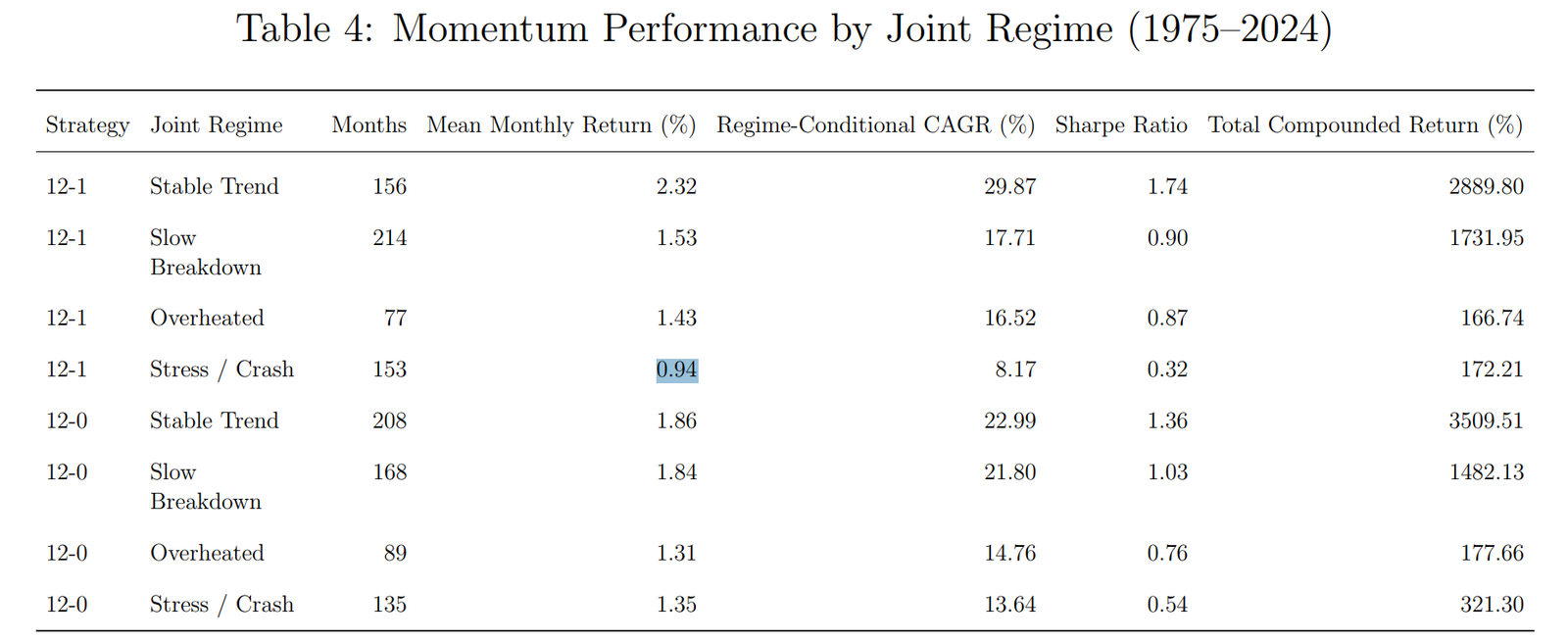
Stable trend (strong return + low volatility): The ideal environment for momentum. The 12-1 strategy grew by 2.32% average monthly returns.
Stress/Damage (weak returns + high volatility): The worst environment. The 12-1 strategy only achieved 0.94% average returns, while the 12-0 held up better at 1.35%.
Slow split and overheating: Intermediate regimes showed moderate torque performance.
Across these joint regimes, the 12-0 strategy exhibited remarkably consistent average returns (ranging from 1.31% to 1.86%), while the 12-1 strategy fluctuated more dramatically (0.94% to 2.32%).

Results are hypothetical results and are NOT an indication of future results and do NOT represent returns actually achieved by any investor. Indices are not managed and do not reflect management or trading fees, and one cannot invest directly in an index.
His findings led Dikhi to the conclusion:
“While the study focuses on industry portfolios only over the long run and does not include transaction costs, leverage or shorting, the results provide clear evidence that the most recent month has predictive value.”
Key Investor Relations
1. The rule of skipping the month is not suitable for everyone
The conventional month-skip rule serves a purpose, but is not universally optimal. The research suggests a conditional approach: consider using the 12-1 strategy (excluding the last month) when the previous month showed strong performance, as this reinforces the continuation of the momentum. But when the previous month was weak, the 12-0 strategy (including the last month) may be preferable, as it stabilizes returns and reduces downside exposure.
2. Pay attention to recent volatility, not just returns
Volatility in the most recent month proved to be as important as – if not more important than – the direction of returns. High volatility consistently predicted poorer momentum performance, even when returns were positive. Investors should monitor not only whether the market is up or down, but how rough the ride has been.
3. Momentum works best in sustained uptrends
The Sustained Trend regime – characterized by strong recent returns and calm markets – delivered the best performance of the moment so far. During these periods, the 12-1 strategy generated compound annual growth rates in excess of 29%. In contrast, stress/crash environments (weak returns plus high volatility) were clearly unfavorable, producing returns of less than half this level.
4. Consider stability versus sensitivity in portfolio design
Investors face a trade-off: the 12-1 strategy offers higher upside in favorable conditions but greater downside in unfavorable ones, while the 12-0 strategy offers more consistent performance across market regimes. Your choice should depend on your risk tolerance and ability to dynamically adjust strategies based on market conditions.
5. The most recent month contains diagnostic information
Perhaps the most important insight is that the most recent month should not be dismissed as mere noise. It provides valuable signals about market conditions, trend strength and momentum stability. Rather than mechanically dismissing this information, sophisticated investors can use it to understand and potentially predict how their current strategies will perform in the near term.
conclusion
This research reformulates the leap month convention from a universal best practice to a conditional tool. The behavior of the most recent month—both its returns and its volatility—contains meaningful information about short-term momentum outcomes. By paying attention to these signals, investors can better understand when their current strategies are likely to thrive or struggle.
The implications extend beyond simply choosing between the 12-1 and 12-0 strategies. The findings suggest that adaptive approaches—which adjust strategy parameters based on recent market conditions—may offer advantages over static rules. As markets evolve, so must our strategies to capture the momentum.
For investors of the moment, the message is clear: don’t let the last month go by without a habit. Understand what it tells you about market conditions and use that information to your advantage.
Larry Swedroe is the author or co-author of 18 books on investing, including his latest Enrich your future. This article is for informational and educational purposes only and should not be construed as specific investment, accounting, legal or tax advice.
–
Important discoveries
For informational and educational purposes only and should not be construed as specific investment, accounting, legal or tax advice. Some information is considered reliable, but its accuracy and completeness cannot be guaranteed. Third-party information may become outdated or otherwise replaced without notice. Neither the Securities and Exchange Commission (SEC) nor any other federal or state agency has approved, determined the accuracy, or confirmed the adequacy of this article.
The views and opinions expressed herein are those of the author and do not necessarily reflect the views of Alpha Architect, its affiliates, or its employees. Our full disclosures are available here. Definitions of common statistics used in our analysis are available here (in the last direction).
Join thousands of other readers and subscribe to our blog.